The right size for rooftop solar comes from three things: how many units you use in a year, how much clear roof you have, and your sanctioned load. Get those right and the system pays back fast. This guide uses the PIB sizing table and BSES output figures, then works through three real-world bill sizes. The calculator at the end does it for your own bill.
How many solar panels do I need for my home?
Divide your average monthly units by about 110 to get the kW you need, then double it for the number of 500 W panels. A home using 330 units a month needs about 3 kW, which is six panels.
That rule works because 1 kW of rooftop solar in Delhi NCR makes about 3 to 4 units a day, or 100 to 120 units a month according to BSES. Over a full year it is roughly 1,400 to 1,450 units per kW in NCR and about 1,300 to 1,450 in the Chandigarh tricity. Use your yearly total from 12 bills if you can; one bill can mislead. A January bill alone makes you undersize, and a June bill alone makes you oversize.
How do I size solar from my electricity bill?
Find the units (kWh) on each of your last 12 bills, add them up and divide by 12. Then use the PIB sizing guide published for PM Surya Ghar in March 2025.
| Average units a month | Suggested size (PIB) | Central subsidy |
|---|---|---|
| 0 to 150 | 1 to 2 kW | ₹30,000 to ₹60,000 |
| 150 to 300 | 2 to 3 kW | ₹60,000 to ₹78,000 |
| Above 300 | Above 3 kW | ₹78,000 (capped) |
Some NCR bills cover two months, so check the billing period before you divide. If you only know the rupee amount, divide the bill by your average rate per unit to get units.
How much roof area do I need per kW?
Roughly 80 to 100 sq ft of shade-free roof per kW. A 3 kW system needs about 240 to 300 sq ft, and 5 kW needs about 400 to 500 sq ft.
| Size | Panels (500 W+) | Shade-free roof | Units a month | Units a year (NCR) |
|---|---|---|---|---|
| 1 kW | 2 | 80 to 100 sq ft | 100 to 120 | 1,400 to 1,450 |
| 2 kW | 4 | 160 to 200 sq ft | 200 to 240 | 2,800 to 2,900 |
| 3 kW | 6 | 240 to 300 sq ft | 300 to 360 | 4,200 to 4,350 |
| 4 kW | 8 | 320 to 400 sq ft | 400 to 480 | 5,600 to 5,800 |
| 5 kW | 10 | 400 to 500 sq ft | 500 to 600 | 7,000 to 7,250 |
| 7 kW | 14 | 560 to 700 sq ft | 700 to 840 | 9,800 to 10,150 |
| 10 kW | 20 | 800 to 1,000 sq ft | 1,000 to 1,200 | 14,000 to 14,500 |
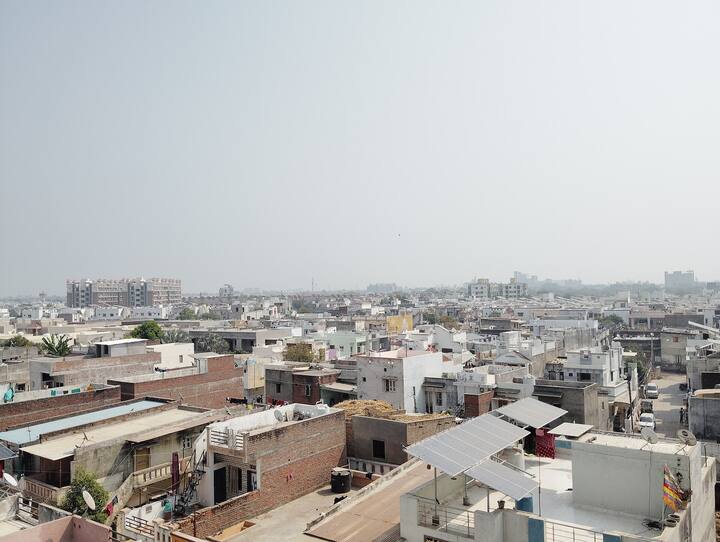
"Shade-free" is the catch. The roof water tank, the staircase mumty, a dish antenna, a neighbour's extra floor and the parapet all cast shadows, and Delhi's winter sun is low. A 1,000 sq ft roof in a South Delhi kothi may have only 500 sq ft that is truly clear. A raised structure can lift panels above tanks and parapets and give some of that space back.
How many panels make 1 kW?
About two. Most good modules are now 500 W or more, so two make roughly 1 kW and six make 3 kW. A few years ago smaller panels were common, so older quotes show more panels for the same kW.
Fewer, larger panels mean fewer clamps and joints, and they fit long, narrow roofs well. On a builder floor with a tight roof, higher-wattage TOPCon panels can squeeze in a little more output from the same area. For the subsidy, every panel must be DCR (India-made cells and modules), and from 1 June 2026 the cells must be on ALMM List-II for net-metered projects.
Worked examples: 200, 400 and 800 units a month
Here is how we would size three typical NCR homes, before seeing the roof.
200 units a month: a small family or a builder floor
Yearly use is about 2,400 units. PIB suggests 2 to 3 kW for 150 to 300 units. A 2 kW system makes about 200 to 240 units a month, so it covers the bill. That is four panels on 160 to 200 sq ft, with ₹60,000 in central subsidy. If you plan an AC upgrade or an EV soon, 3 kW gets the full ₹78,000 and leaves headroom.
400 units a month: a typical kothi with two ACs
Yearly use is about 4,800 units. At 1,400 to 1,450 units per kW a year, 3.5 kW makes about 4,900 to 5,075 units, which is close to an exact match. That is seven panels on about 280 to 350 sq ft. Going to 4 kW (eight panels) gives margin for haze and dust years. The central subsidy is ₹78,000 either way.
800 units a month: a large home, heavy AC use
Yearly use is about 9,600 units. Around 7 kW (14 panels) makes about 9,800 to 10,150 units a year and needs 560 to 700 sq ft of clear roof. Two checks matter here: whether the roof has that much shade-free area, and whether your sanctioned load allows 7 kW. Many homes at this level need a load enhancement first. The subsidy is still ₹78,000, so the extra kW pay back through the bill alone.
What does sanctioned load have to do with it?
Sanctioned load sets the largest system you can connect without extra paperwork. In UP a home system can be up to 100% of sanctioned load. Other DISCOMs also link size to load, and Haryana's ceiling for net metering is 500 kW.
Your sanctioned load is printed on the bill. Many NCR homes have a load set before the ACs arrived. If you want a bigger system, file a load enhancement first or along with the solar application. Our net metering guide covers this per DISCOM.
How should AC-heavy summer homes size solar?
Size for the year, not for June. Your May and June bills may be far higher than December's, but net metering carries spring surplus forward to the summer months, so the yearly total is the number that counts.
In NCR, March to May are the strongest months for output, before monsoon cloud and winter haze set in. Summer heat and the May to June dust lower panel output a little, which is one reason to keep panels clean (see our smog and dust guide). In Delhi, surplus left at the end of the settlement year is paid at the APPC rate, which is lower than what you pay for power, so oversizing to cover the peak month usually earns little on the last few kW.
Surya's chariot runs on seven horses, not seventeen. A system matched to your year pulls better than one built for your hottest week.
Try it with your own bill
Pick your city, move the slider to your average monthly bill and enter your rate per unit. The calculator suggests a size, shows your subsidy and state top-up, and estimates what you pay and how fast it comes back.
Rate per unit = bill amount ÷ units on the bill. Leave the default if you are not sure. Home systems only; for societies and businesses we size from the load on site.
- Typical price before subsidy
- Central subsidy (PM Surya Ghar)
- State top-up
- You pay, roughly
- Bill saving
- Payback
- Savings over 25 years
An estimate, not a quote. Prices use typical 2026 NCR rates; 25-year savings assume 3% yearly tariff rise and 0.5% yearly panel ageing, and count only units you would otherwise buy.
The calculator is an estimate. Roof shade, sanctioned load and your DISCOM's rules decide the final size, and we check all three at survey.
Not sure how much of your roof is really usable? Book a free roof survey and we will map shade through the day, read your sanctioned load and suggest the right number of panels. Local detail is on our pages for Delhi, Gurugram, Noida, Greater Noida, Ghaziabad, Faridabad and Chandigarh.