| DISCOM | PVVNL |
|---|---|
| State nodal agency | UPNEDA |
| Central subsidy | Up to ₹78,000 (3 kW and above) |
| UP top-up | ₹15,000 per kW, up to ₹30,000 |
| Loan | SBI 6.00% up to ₹2 lakh, collateral-free |
| Net metering | UPERC RSPV 2019, up to 100% of sanctioned load |
| Yearly output | About 1,400 to 1,450 units per kW |
Is rooftop solar worth it in Ghaziabad?
Yes. Ghaziabad homes get the full Uttar Pradesh top-up on top of the central subsidy, so a 3 kW system comes down to about ₹1.12 to 1.32 lakh, and the units it makes come off your PVVNL bill every month. With subsidy, payback in NCR is typically 3 to 4 years, and the UP top-up can shorten it.
Worked example: 3 kW for a family using about 250 units a month
The PM Surya Ghar sizing guide puts homes using 150 to 300 units a month at 2 to 3 kW. Take a 3 kW system at 2026 market prices of about ₹2.2 to 2.4 lakh. Subtract ₹78,000 central subsidy and ₹30,000 UP subsidy, together ₹1.08 lakh, and your net cost is about ₹1.12 to 1.32 lakh. It makes roughly 4,200 to 4,350 units a year, so your rough yearly saving is those units at your PVVNL rate.
Worked example: 5 kW for a larger house
Homes above 300 units a month usually need more than 3 kW. A 5 kW system costs about ₹3.3 to 3.6 lakh. The subsidy is capped at the same ₹1.08 lakh, so you pay about ₹2.22 to 2.52 lakh. It makes about 7,000 to 7,250 units a year, enough to cover most of a joint family's daytime AC and pump use in summer.
EMI that fits inside the saving
Under PM Surya Ghar, SBI lends collateral-free at 6.00% up to ₹2 lakh, floating from 15 October 2026, with up to 10 years to repay and no processing fee. A Ghaziabad 3 kW system after subsidy fits in that band. Read the loan guide.
Figures are as of November 2026. For your own numbers, use the solar calculator or send us a recent bill.
How do I claim the subsidy through PVVNL?
You apply on the national portal, PVVNL handles the connection side and UPNEDA is the state nodal agency. We do the filing for you, but here is what happens:
- Register on pmsuryaghar.gov.in with your PVVNL account number and apply.
- Choose a registered vendor; PVVNL checks feasibility for your connection.
- Upload the agreement, install India-made DCR panels, and the vendor uploads the details and DCR certificate.
- PVVNL inspects and fits the net meter, and the commissioning certificate is issued.
- You add bank details and redeem. UPNEDA says the central subsidy is paid within 30 days.
You need to own the house, have a valid residential connection and not have taken another rooftop subsidy before. If the house or the connection is in a parent's name, we check at the survey whose name the application should go in.
Net metering in Ghaziabad: the sanctioned load rule
PVVNL follows UPERC's 2019 RSPV regulations, which let you install up to 100% of your sanctioned load. In Ghaziabad this matters more than people expect, because many older houses in Kavi Nagar, Raj Nagar and Nehru Nagar still carry a load sanctioned decades ago.
If your sanction is 2 kW and you need 4 kW, we first apply to PVVNL for a load increase, then for net metering. After installation PVVNL inspects and fits a bidirectional meter. From then on, units you export at midday are set against units you use at night, and your bill shows the net. See net metering in Delhi NCR.
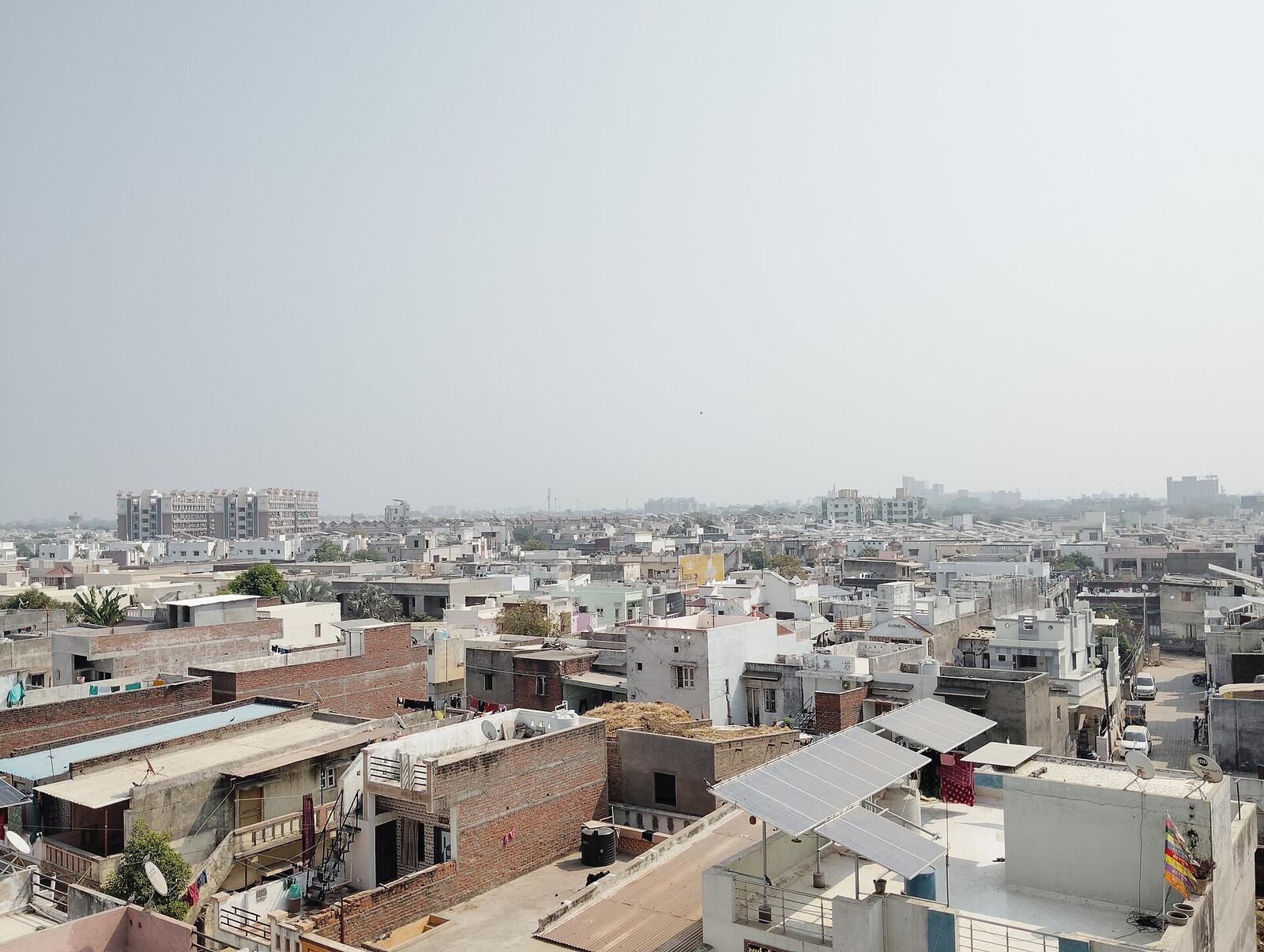
Kavi Nagar kothis, Vaishali houses and old roofs
Ghaziabad's independent houses are some of the most solar-ready roofs in NCR. Kavi Nagar, Raj Nagar and the older Vaishali and Shalimar Garden blocks have flat RCC terraces, often with room for a 5 kW system or larger. You need about 80 to 100 sq ft of shade-free roof per kW.
Three things come up often on these roofs:
- Age. Many roofs were laid twenty or thirty years ago. We check for seepage and cracks, and suggest waterproofing first if the roof needs it.
- Upper-floor additions. Families add a floor or a barsati over time, and neighbours do the same. We map shade through the day before placing a single panel.
- Daily use. Terraces here are for drying clothes, winter sun and the occasional function. A raised structure keeps the space free underneath.
If your area sees power cuts, decide on backup early. An on-grid system switches off during a cut for safety, so either keep your existing inverter for backup or go hybrid with a battery. Our on-grid vs hybrid guide compares them.
How big a system does your house need?
Start with your bill, not your roof. Take your average monthly units over a year: under 150 suggests 1 to 2 kW, 150 to 300 suggests 2 to 3 kW, and above 300 means more than 3 kW. Then check the roof can hold it at 80 to 100 sq ft per kW, and that PVVNL's sanctioned load allows it. Our sizing guide walks through it.
Plan for cleaning too. Ghaziabad's dust in May and June and haze from November to January both settle on panels, and UPNEDA suggests a wash about every 15 days. Early morning, plain water, a soft mop: that is all it takes.
Indirapuram and Raj Nagar Extension societies
Societies in Indirapuram, Vaishali's group housing and the newer towers of Raj Nagar Extension and Crossings Republik can cut their common-area bills with a rooftop system. The roof belongs to the AOA, so the system runs lifts, pumps, lighting and the clubhouse. Common facilities get ₹18,000 per kW in central subsidy, up to 500 kW.
Older Indirapuram societies tend to have mid-rise blocks with many separate roofs; Raj Nagar Extension has taller towers with one big roof each and more lift machinery. We design for each, and give the committee a proposal to circulate before the AGM. See solar for societies.
Factories in Sahibabad and along the Meerut Road industrial belt pay commercial tariffs, so solar pays back fastest there. Read about commercial solar.
Why Konarq in Ghaziabad
We have done 300+ installations across NCR and the tricity, and we know how PVVNL's process runs, office by office. One team handles all seven steps: bill check, roof survey, design and fixed quote, paperwork, installation, net meter and inspection, and subsidy. The Konark wheel on your ₹10 note was carved to read the sun; our job is simply to put that sun to work on your roof.
You also get five years of care: maintenance, a cleaning routine for the dusty months and app monitoring. Panels keep at least 90% output at 12 years and 80% at 25 years.
See what your Ghaziabad roof can do. Book a free roof survey and get one fixed price with the ₹1.08 lakh subsidy worked in.