| DISCOMs | BSES Rajdhani, BSES Yamuna, Tata Power-DDL, NDMC |
|---|---|
| Central subsidy | Up to ₹78,000 (3 kW and above) |
| Delhi top-up | ₹10,000 per kW, up to ₹30,000, credited in your bill |
| State portal | solar.delhi.gov.in |
| Feasibility | 15 days, deemed approved if the DISCOM does not reply (DERC, July 2026) |
| Fees | Waived for homes up to 10 kW |
| Yearly output | About 1,400 to 1,450 units per kW |
How much does rooftop solar cost in Delhi?
A typical Delhi home pays about ₹1.12 to 1.32 lakh for a 3 kW system after subsidy, and about ₹2.22 to 2.52 lakh for 5 kW. That is the 2026 market price of roughly ₹55,000 to ₹75,000 per kW, minus the PM Surya Ghar subsidy and the Delhi top-up. Here is how the numbers stack up, as of November 2026.
| 3 kW | 5 kW | |
|---|---|---|
| Price before subsidy | ₹2.2 to 2.4 lakh | ₹3.3 to 3.6 lakh |
| Central subsidy (PM Surya Ghar) | ₹78,000 | ₹78,000 |
| Delhi top-up (credited in bill) | ₹30,000 | ₹30,000 |
| Your net cost | ₹1.12 to 1.32 lakh | ₹2.22 to 2.52 lakh |
| Units a year | 4,200 to 4,350 | 7,000 to 7,250 |
| Rough yearly saving | 4,200+ units you no longer buy | 7,000+ units you no longer buy |
To see the saving in rupees, multiply those units by the per-unit rate on your bill. BSES puts the typical payback with subsidy at 3 to 4 years. A 3 kW system suits a home using 150 to 300 units a month; above 300, 5 kW or more usually makes sense. Our price guide breaks the cost down further, and the calculator works from your own bill.
What subsidy is available in Delhi in 2026?
Delhi has three layers to know about: the central subsidy, the Delhi top-up, and the newer zero-cost scheme announced in September 2026. Most families today get the first two.
Central subsidy
PM Surya Ghar: Muft Bijli Yojana pays ₹30,000 per kW for the first 2 kW and ₹18,000 for the third, capped at ₹78,000. It goes straight to your bank account after the net meter is fitted and the commissioning certificate is issued. You need to own the house, have a valid residential connection and not have taken another rooftop subsidy. The scheme runs to 31 March 2027.
Delhi Solar Policy top-up
The Delhi Solar Policy was notified on 14 March 2024, and its first amendment in July 2025 added a state top-up of ₹10,000 per kW, up to ₹30,000. Unlike the central subsidy, this comes as a credit in your electricity bill.
The zero-cost 3 kW announcement
The Delhi cabinet approved a second amendment on 1 September 2026, reported as notified on 17 September 2026. It announced zero-cost rooftop solar up to 3 kW for households averaging up to 400 units a month, with five years of maintenance, delivered through an IPGCL tender. It has been reported that the state subsidy becomes the lower of the tender cost minus the central subsidy, or ₹26,000 per kW, up to ₹78,000, and that the policy now runs to 31 March 2030. Because this is still rolling out, we confirm your figure at survey and tell you honestly which route costs you less.
What about GBI?
Delhi used to pay a generation based incentive of ₹3 per unit for systems up to 3 kW and ₹2 per unit for 3 to 10 kW. It has been reported as discontinued for new home systems after the second amendment. Commercial and industrial systems keep it.
Applying is the same for every Delhi DISCOM: register on pmsuryaghar.gov.in, choose a registered vendor, and the DISCOM checks feasibility. The state side runs through solar.delhi.gov.in. We do both filings for you.
Which DISCOM serves you, and how does net metering work?
Your DISCOM depends on where you live, and it decides who inspects your system and fits the net meter. Delhi has four:
- BSES Rajdhani for south and west Delhi, such as Saket, Vasant Kunj, Dwarka and Janakpuri.
- BSES Yamuna for east and central Delhi, such as Mayur Vihar, Laxmi Nagar and Preet Vihar.
- Tata Power-DDL for north and north-west Delhi, such as Rohini, Pitampura and Model Town.
- NDMC for the Lutyens zone and the New Delhi area around it.
Delhi's rules got faster in 2026. Under the DERC second amendment of 16 July 2026, the DISCOM has 15 days to decide feasibility, and if it does not respond, the application is deemed approved. Fees are waived for home systems up to 10 kW. After installation, the DISCOM inspects, swaps your meter for a two-way net meter and the commissioning certificate follows on the portal.
The net meter counts what you export at noon against what you draw at night. Any surplus left at the end of the year is paid at the APPC rate. Delhi also allows group and virtual net metering, which matters for the shared roofs below. More detail in our net metering guide.
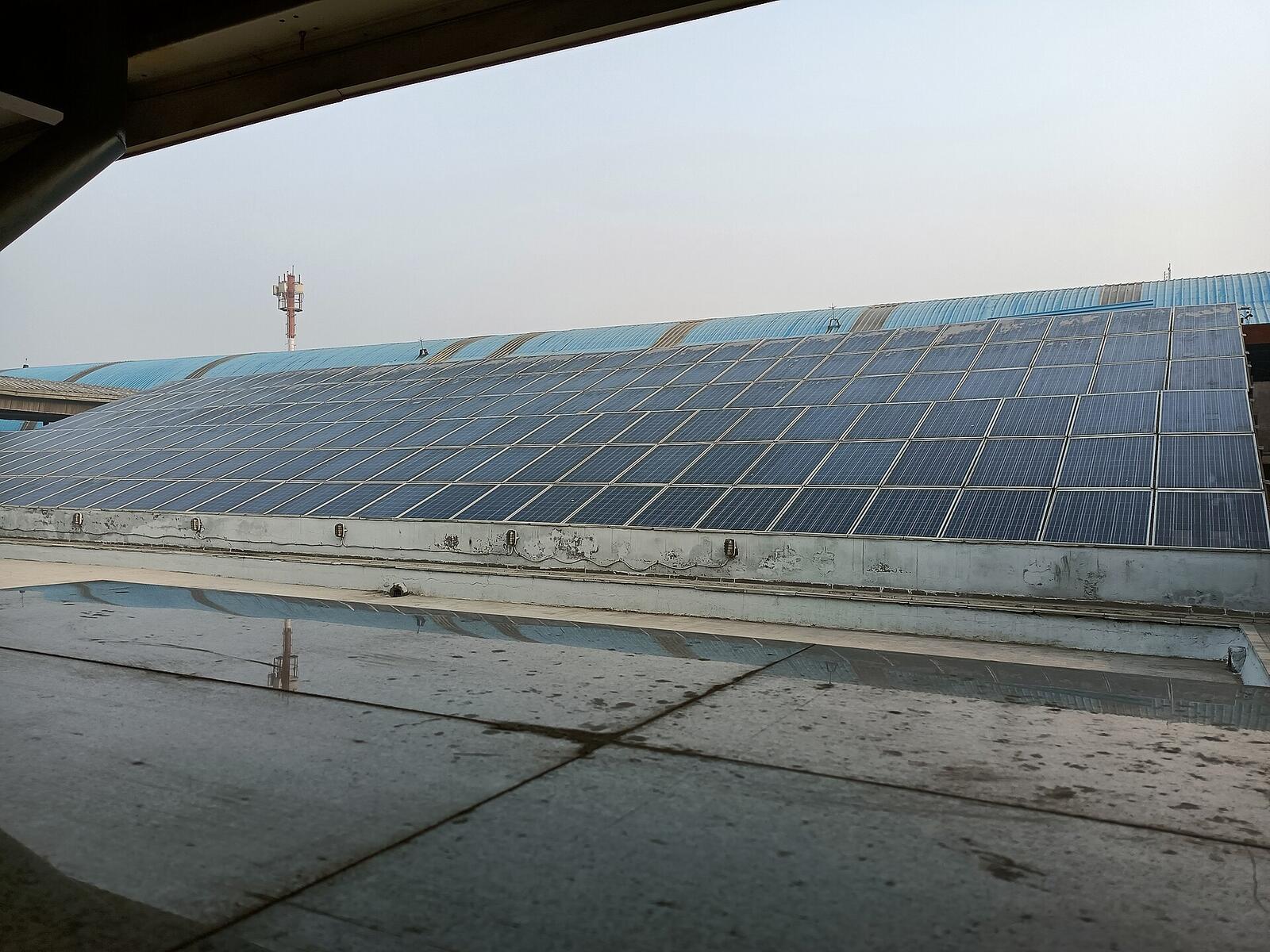
Kothis, builder floors and shared roofs
Most Delhi roofs can take solar. The question is usually who owns the roof and what is already on it. You need roughly 80 to 100 sq ft of shade-free space per kW.
Kothis and independent houses are the simplest. We work around the water tank, the mumty and the dish antenna, and keep panels clear of the shadow from a taller neighbour. A raised structure lets you keep using the terrace for drying clothes or a winter afternoon in the sun.
Builder floors need a quick conversation first. Roof rights often sit with the top-floor owner, or are shared by all floors. If the floors agree to split the roof, each owner can apply on their own connection. If only one floor has roof space, group or virtual net metering can let one system credit more than one bill. We draw the split clearly so everyone at home signs off on the same layout.
Two Delhi details we plan for: monkeys in colonies near the Ridge and older green belts, where we use guarded cabling and sturdier fixings, and the winter haze from November to January, which is why we size on a full year and suggest weekly washing, as BSES does.
Lutyens, NDMC areas and unauthorised colonies
Solar works in every part of Delhi, but the paperwork route differs. In the NDMC area, NDMC is your DISCOM, and private bungalows follow the same PM Surya Ghar steps with NDMC doing feasibility and the net meter. Many of these houses are large plots with old, low-slope roofs, so we design low structures that sit quietly behind the parapet.
Many families live in colonies that are still being regularised. The subsidy looks for three things: that you own the house, that you have a valid residential electricity connection, and that you have not taken another rooftop subsidy. If your papers show those, the process is the same as anywhere else. We look at your documents at the survey and tell you plainly what applies.
Societies, CGHS flats and businesses in Delhi
Group housing societies in Dwarka, Rohini and IP Extension can put solar on the common roof for lifts, pumps and corridor lighting. Common facilities get ₹18,000 per kW in central subsidy, up to 500 kW. We present to the managing committee and prepare what the AGM needs. See solar for societies.
Shops, offices and small factories pay commercial rates, so solar pays back fastest there, and commercial and industrial systems in Delhi still keep GBI. Read more on commercial solar.
Why Konarq in Delhi
We have done 300+ installations across NCR and the tricity, and we know how each Delhi DISCOM runs its queue. Konark's builders turned a whole temple towards the sunrise; we only need to turn your panels south. Every job follows the same seven steps:
-
1Horse 1 · Gayatri
Bill check
Share a recent electricity bill. We read your load, slab and usage pattern, and tell you the size that makes sense. Usually the same day.
-
2Horse 2 · Brihati
Roof survey
An engineer visits, checks the roof, measures shade through the day, notes the parapet, water tank and structure, and photographs the meter board.
-
3Horse 3 · Ushnik
Design and fixed quote
You get a layout, the expected yearly units, the subsidy you qualify for and one fixed price. No surprises added on installation day.
-
4Horse 4 · Jagati
Paperwork
We file on the PM Surya Ghar portal and with your DISCOM for feasibility and net metering, and track every approval for you.
-
5Horse 5 · Trishtubh
Installation
Rust-proof structure, India-made panels, inverter, earthing and lightning protection. Most homes are done in one to three days on the roof.
-
6Horse 6 · Anushtubh
Net meter and inspection
Your DISCOM inspects the system and fits the net meter. Then the commissioning certificate is issued on the portal.
-
7Horse 7 · Pankti
Subsidy and care
You redeem the subsidy, which goes straight to your bank account. We stay on for five years of maintenance, cleaning advice and app monitoring.
We use India-made DCR panels so you qualify for the subsidy, with module warranties of at least 90% output at 12 years and 80% at 25 years. Inverter, structure and workmanship carry five years of warranty, and five years of maintenance comes with every home system.
Want to know what your roof can do? Book a free roof survey and an engineer will visit, measure the shade and give you one fixed price.