| DISCOM | NPCL (Noida Power Company Limited) |
|---|---|
| Development authority | GNIDA |
| State nodal agency | UPNEDA |
| Central subsidy | Up to ₹78,000 (3 kW and above) |
| UP top-up | ₹15,000 per kW, up to ₹30,000 |
| Net metering | UPERC RSPV 2019, up to 100% of sanctioned load |
| Yearly output | About 1,400 to 1,450 units per kW |
What does rooftop solar cost in Greater Noida?
A 3 kW system in Greater Noida costs about ₹1.12 to 1.32 lakh after subsidy, and a 5 kW system about ₹2.22 to 2.52 lakh. You are in Uttar Pradesh, so the state top-up applies even though your DISCOM is NPCL. The working below uses 2026 market prices, as of November 2026.
- 3 kW: ₹2.2 to 2.4 lakh before subsidy, minus ₹78,000 central and ₹30,000 UP subsidy, leaves ₹1.12 to 1.32 lakh. It makes about 4,200 to 4,350 units a year.
- 5 kW: ₹3.3 to 3.6 lakh before subsidy, minus the same ₹1.08 lakh, leaves ₹2.22 to 2.52 lakh. It makes about 7,000 to 7,250 units a year.
If you would rather pay monthly, SBI's collateral-free PM Surya Ghar loan is 6.00% up to ₹2 lakh (floating, from 15 October 2026), for up to 10 years with no processing fee. A 3 kW system after subsidy fits in that band. See solar loans and EMI.
Your rough yearly saving is those units multiplied by the per-unit rate on your NPCL bill. With subsidy, payback in NCR is typically 3 to 4 years, and the UP top-up can bring it in sooner. A 3 kW system suits a home using 150 to 300 units a month; above 300, look at 5 kW. The calculator works it out from your own bill.
How does the NPCL rooftop solar process work?
NPCL runs the technical side, and the subsidy runs through the national portal. NPCL is a private company that supplies power under UP rules, so the steps match the rest of Uttar Pradesh.
- Register on pmsuryaghar.gov.in, choose Uttar Pradesh and NPCL as your DISCOM, and enter your NPCL account number.
- Pick a registered vendor. NPCL checks feasibility on your connection and transformer.
- Upload the signed agreement. We install with India-made DCR panels and upload the details and DCR certificate.
- NPCL inspects the system and fits a bidirectional net meter.
- The commissioning certificate is issued. You add bank details and redeem; UPNEDA says the central subsidy arrives within 30 days by direct transfer, with the UP top-up on top.
Net metering follows UPERC's 2019 RSPV regulations: your system can be up to 100% of your sanctioned load. If your load is lower than the system you need, we apply to NPCL to raise it first. Your monthly bill then shows import, export and the net. Read our net metering guide for how credits carry forward.
One more check that is easy to miss: from 1 June 2026, net-metered projects need ALMM List-I modules with List-II cells. Every system we install in Greater Noida uses India-made DCR panels that meet this, so your subsidy and your net meter are both safe.
GNIDA plots in Alpha, Beta, Gamma and beyond
Greater Noida's independent houses sit on GNIDA plots in sectors like Alpha, Beta, Gamma, Delta, Chi, Pi and Swarn Nagri. These are some of the best solar roofs in NCR: wide plots, newer construction, few tall neighbours and broad roads that keep shade away.
That openness has a cost: dust. Construction across the newer sectors and the open land around them means panels coat quickly in May and June. A Delhi study found unwashed panels lose 0.3 to 0.6% a day in the dry season, and UPNEDA suggests cleaning about every 15 days. We place panels so they are easy to reach with a hose, and add a tap point on the roof if there is not one.
Wind is the other local factor. Open sectors catch strong pre-monsoon gusts, so we use a rust-proof structure anchored for the exposure, not a light frame borrowed from a sheltered city roof. Water tanks and the mumty go on the north side of the layout where we can, so their shadow falls off the panels.
On backup: an on-grid system switches off during a power cut, for the safety of anyone working on the lines. If your house relies on an inverter today, keep it, or ask about a hybrid system with its own battery. Our on-grid vs hybrid guide explains the trade-off in plain terms.
Greater Noida West societies and single-point connections
For most Greater Noida West (Noida Extension) residents, solar means a society system rather than a flat-by-flat one. The towers have big roofs, and the common loads, lifts, pumps, basement lighting and the clubhouse, run all day.
Many societies here take power on a single-point bulk connection, where the society is NPCL's consumer and each flat is billed by the society or maintenance agency. In that setup an individual flat cannot apply for PM Surya Ghar alone. What does work is a common-area system: it gets ₹18,000 per kW in central subsidy, up to 500 kW, and the saving shows up in lower maintenance charges for everyone. Societies with individual NPCL connections have both options.
We survey the roof, map lift rooms, water tanks and telecom equipment, and give the AOA a layout and one fixed price to put before the AGM. See solar for societies for how we work with committees.
Colleges, schools and factories
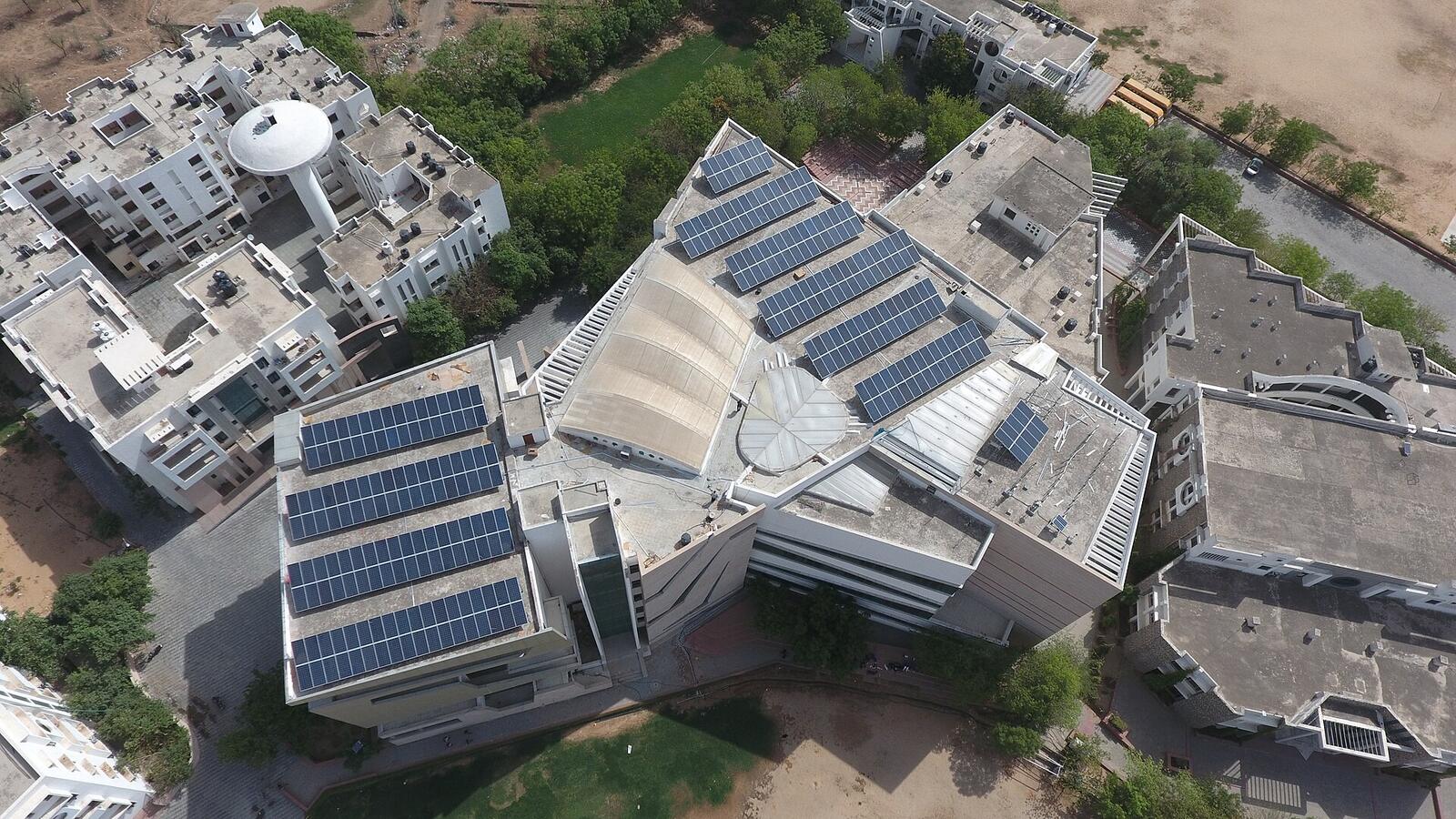
Greater Noida has an unusual mix of daytime users: colleges and universities in Knowledge Park, schools across the sectors and factories in the Ecotech and Kasna industrial areas. All three suit solar well, because they use power when the sun is up and have large roofs.
For institutions, the system can cover classrooms, labs and hostel pumps. For factories, metal sheet roofs need a different mounting from RCC, and we check the sheet and purlins before proposing anything. Commercial and industrial users pay higher tariffs, so the payback is the fastest of all. Read commercial solar.
Why Konarq in Greater Noida
We have done 300+ installations across NCR and the tricity, and we know how NPCL's process differs from PVVNL's next door. You deal with one team for all seven steps: bill check, roof survey, design and fixed quote, paperwork, installation, net meter and inspection, then subsidy and care. Like Aruna driving Surya's chariot at dawn, we handle the reins; you only watch the meter.
Every home system includes five years of care: maintenance, cleaning advice suited to Greater Noida's dust and app monitoring. Panels are India-made with at least 90% output at 12 years and 80% at 25 years.
Curious what your plot or society roof can do? Book a free roof survey and an engineer will visit and give you one fixed price.