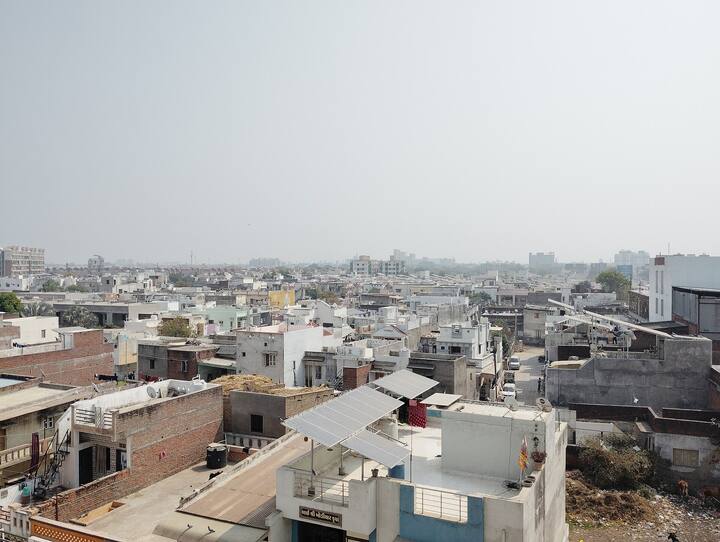
For most homes, rooftop solar is a one-time spend of one to three lakh rupees that pays back over a few years. If you would rather spread that out, PM Surya Ghar comes with collateral-free loans at low rates. This guide covers the loan terms as of November 2026, works out EMIs with the standard formula, and compares them with what the system saves. It also covers options for businesses and societies.
Can I get a loan for rooftop solar under PM Surya Ghar?
Yes. Homes installing under PM Surya Ghar can take a collateral-free loan from banks lending under the scheme. As of November 2026, SBI lends at 6.00% for loans up to ₹2 lakh and 8.15% for loans of ₹2 to 6 lakh, for up to 10 years.
| Term | SBI, as of November 2026 |
|---|---|
| Interest, loans up to ₹2 lakh | 6.00% (effective 15 October 2026) |
| Interest, loans of ₹2 to 6 lakh | 8.15% |
| Rate type | Floating |
| Tenure | Up to 10 years |
| Margin (your share) | 10% of project cost |
| Collateral | None |
| Processing fee | None |
Floating means the rate moves with the bank's benchmark. If rates rise, your EMI or tenure can go up; if they fall, the reverse. Other banks offer similar loans under the scheme; compare their current rates when you apply.
How is a solar loan EMI worked out?
Banks use the standard EMI formula: EMI = P × r × (1 + r)n ÷ ((1 + r)n - 1), where P is the loan amount, r is the yearly rate divided by 12 (as a decimal) and n is the number of months.
For ₹2 lakh at 6% over 10 years: r = 0.06 ÷ 12 = 0.005 and n = 120. (1.005)120 is about 1.8194, so EMI = 2,00,000 × 0.005 × 1.8194 ÷ 0.8194, which is roughly ₹2,220. Like Konark's 24 wheels turning the sun's path into steady time, an EMI turns a lump sum into even monthly steps.
| Loan | Rate | 5 years | 7 years | 10 years |
|---|---|---|---|---|
| ₹2 lakh | 6.00% | About ₹3,870 | About ₹2,920 | About ₹2,220 |
| ₹3 lakh | 8.15% | About ₹6,100 | About ₹4,700 | About ₹3,660 |
| ₹5 lakh | 8.15% | About ₹10,170 | About ₹7,830 | About ₹6,110 |
These EMIs are approximate, rounded to the nearest ₹10, and assume the rate stays the same through the loan. Your bank's sanction letter gives the exact figure.
Worked example: what is the EMI on a 3 kW system?
Roughly ₹2,200 a month over 10 years. Here is the full working for a 3 kW home system priced at ₹2.2 lakh, the lower end of the NCR range of about ₹2.2 to 2.4 lakh.
- System price: ₹2,20,000
- Your 10% margin: ₹22,000, paid upfront
- Loan: ₹1,98,000 at 6.00% (under ₹2 lakh)
- EMI over 10 years: about ₹2,200 (total interest about ₹65,800)
- EMI over 7 years: about ₹2,890 (total interest about ₹45,000)
- EMI over 5 years: about ₹3,830 (total interest about ₹31,700)
Then the subsidy arrives. The ₹78,000 central subsidy is paid to your bank account after commissioning. If you put it into the loan as a part-prepayment and keep the 10-year term, a balance of about ₹1.2 lakh at 6% works out to roughly ₹1,330 a month. Or keep the EMI the same and finish years earlier. In UP the state subsidy adds up to ₹30,000 more. In Delhi the 2025 state top-up of up to ₹30,000 is credited in your electricity bill rather than paid as cash.
Will my bill saving cover the EMI?
For a well-sized home system, roughly yes. In NCR 1 kW makes about 100 to 120 units a month, so 3 kW makes about 300 to 360 units. At an example rate of ₹7.5 per unit, that is about ₹2,250 to ₹2,700 a month off your bill, against an EMI of about ₹2,200.
| System | Loan and term | EMI (approx.) | Units a month | Saving at ₹7.5 a unit (example) |
|---|---|---|---|---|
| 3 kW at ₹2.2 lakh | ₹1.98 lakh, 6.00%, 10 yrs | ₹2,200 | 300 to 360 | ₹2,250 to ₹2,700 |
| 3 kW, subsidy prepaid | About ₹1.2 lakh, 6.00%, 10 yrs | ₹1,330 | 300 to 360 | ₹2,250 to ₹2,700 |
| 5 kW at ₹3.3 lakh | ₹2.97 lakh, 8.15%, 10 yrs | ₹3,630 | 500 to 600 | ₹3,750 to ₹4,500 |
Your own rate per unit is your bill amount divided by the units billed. Homes in higher slabs save more per unit, because solar cuts the most expensive units first. The solar calculator lets you enter your own rate.
How do I apply for a solar loan?
Apply for the loan alongside your PM Surya Ghar application, once you have chosen a vendor and have a quote. The bank usually pays the vendor directly; you pay the 10% margin.
- Registration and application on pmsuryaghar.gov.in
- The vendor's quote for the system
- Your KYC documents and latest electricity bill
- Proof of ownership of the house
- Bank statements, if the bank asks for income proof
We share the quote and technical details with your bank in the format it needs. Our subsidy guide covers the rest of the application.
What should I check before signing the loan?
Read the sanction letter for five things: the rate and how it resets, the tenure, part-prepayment terms, any insurance or add-ons bundled in, and when the bank releases money to the vendor. Two minutes on each saves surprises later.
- Rate reset. The loan is floating. Ask which benchmark it follows and how often the rate resets.
- Part-prepayment. Confirm you can put the subsidy into the loan, and whether the bank then lowers the EMI or shortens the tenure. Choose the one that suits you.
- Add-ons. Loan insurance or other products are sometimes offered with a loan. Take them only if you want them.
- Disbursement. Check whether the bank pays the vendor in one go or in stages, and keep receipts for your 10% margin.
- Account for the subsidy. The subsidy goes to the bank account you enter on the portal. Using the same bank as the loan makes the prepayment simple.
What finance options do businesses have?
Shops, offices, schools and factories do not use PM Surya Ghar loans, which are for homes. They usually choose between paying upfront, a term loan from a bank or NBFC, or a zero-capex RESCO arrangement.
Commercial tariffs are higher than domestic ones, so solar often pays back fastest on business roofs. Businesses that own the system may also be able to claim depreciation on solar assets, which can lower tax in the early years. The rules depend on your entity and books, so ask your CA before you decide. In Delhi, commercial and industrial systems still get the generation-based incentive. More on our commercial solar page.
What is RESCO or zero-capex solar, and who is it for?
Under RESCO, a developer installs, owns and maintains the plant on your roof, and you buy its units at an agreed rate for a fixed number of years. You spend nothing upfront and the developer carries the maintenance.
| Own it (cash or loan) | RESCO / zero-capex | |
|---|---|---|
| Upfront spend | Price less subsidy, or 10% margin with a loan | None |
| Who owns the plant | You | The developer, for the agreed term |
| Maintenance | Vendor for 5 years, then you | Developer |
| Saving over the plant's life | Highest | Lower, since you pay for each unit |
| Best for | Homes, owner-run businesses | Housing societies, businesses that prefer opex |
For a group housing society, RESCO avoids raising a corpus from every flat, which can be hard to pass at an AGM. For an RWA that can fund it, owning the plant with the ₹18,000 per kW common-facility subsidy usually saves more. We present both to the managing committee; see solar for societies.
Want an EMI worked out on your actual quote? Book a free roof survey and we will size the system, give you a fixed price and show the loan and cash options side by side. Local detail is on our pages for Delhi, Gurugram, Noida, Greater Noida, Ghaziabad, Faridabad and Chandigarh.