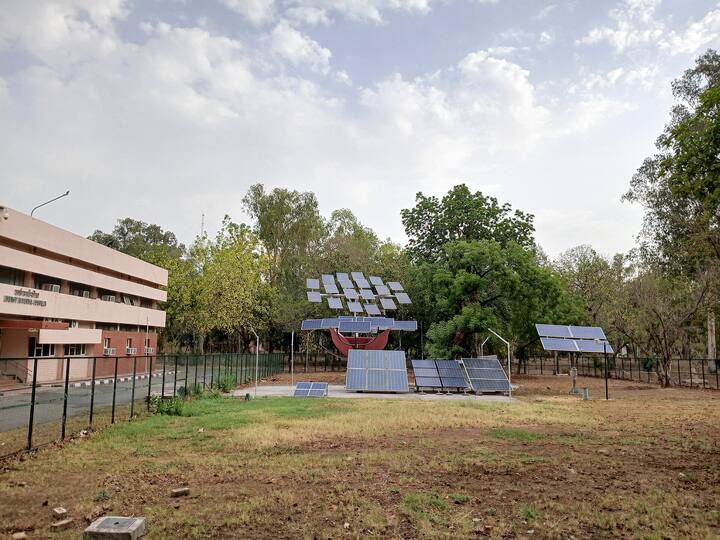
Every NCR roof gets two kinds of dirt: dust that settles on the glass, and haze that sits in the air. Both cut output, and both are worth understanding before you install. This guide uses the Delhi field study by Cleantech Solar, MIT and SERIS (EU PVSEC 2016), cleaning advice from BSES and UPNEDA, and what we see on roofs from Dwarka to Greater Noida.
Do solar panels work in Delhi's smog?
Yes. Haze lowers output on bad days, but over a full year 1 kW of rooftop solar in NCR still makes roughly 1,400 to 1,450 units. Smog can cut a single day's sunlight reaching the panels by 20 to 40%, and research puts the yearly yield loss from haze near Delhi at about 6%.
That 6% is already inside the yearly figures we use for sizing, so it does not change whether solar pays. It does explain why November to January bills save less than March to May. Newer research published in Nature Sustainability in 2026 points the same way: it estimated that aerosols cut India's solar output by about 9.6% in 2023, on top of the dust on the glass. You cannot clean the sky, but you can clean the glass, and that part is in your hands.
How fast does dust build up on panels in Delhi?
Fast. The Delhi study found that unwashed panels lost 0.3 to 0.6% of output every day in the dry season. Over two unwashed weeks, that adds up to roughly 4 to 8%; over a dry month or two it becomes a large loss.
In the same study, cleaning panels that had been left unwashed raised their performance ratio by 27 to 39%. Put simply, panels left dirty in Delhi can be making a fifth to a quarter less than clean ones, and the fix is a bucket of water and a soft mop.
| Finding (Delhi study, EU PVSEC 2016) | Figure |
|---|---|
| Dust loss on unwashed panels, dry season | 0.3 to 0.6% a day |
| Gain in performance ratio after cleaning | 27 to 39% |
| Single-day sunlight lost to haze | 20 to 40% |
| Yearly yield loss from haze near Delhi | About 6% |
How does solar output change through the year in NCR?
Output is highest in March, April and May, dips in the monsoon, and is lowest in the hazy, short days of December and January. A typical year adds up to about 1,440 units per kW.
Net metering smooths this out. Spring surplus is banked and drawn down in the months when output is lower, which is why we size on the full year. Our sizing guide explains how.
How often should I clean solar panels in Delhi NCR?
Weekly to fortnightly. BSES suggests weekly cleaning; UPNEDA suggests about every 15 days. In practice the right interval changes with the season.
| Months | What happens on the roof | Suggested cleaning |
|---|---|---|
| February to April | Strong sun, dry air, steady dust | Weekly to fortnightly |
| May and June | Dust storms, heat, fine dust from construction | Weekly, and after every dust storm |
| July to September | Rain washes loose dust, leaves mud streaks | As needed, after dry spells |
| October and November | Smoke and haze return, soot on the glass | Weekly |
| December and January | Haze, fog and dew that turns dust to a film | Weekly to fortnightly |
Roofs near main roads, construction sites or open plots in new sectors of Noida, Greater Noida and Gurugram collect dust faster. Chandigarh's leafy sectors usually need less, apart from pollen and leaves.
How do I clean solar panels safely?
Use soft water, a soft brush or mop, early in the morning, with no detergent and no pressure jets. Never stand or kneel on the panels.
- Go early. Clean before about 9 am, when the glass is cool and output is low. Cold water on glass that has baked in the afternoon sun can stress it.
- Rinse first. Wet the panels with a gentle hose or bucket to loosen dust, so you do not drag grit across the glass.
- Use a soft tool. A long-handled soft brush or microfibre mop. No scrubbers, no scraping.
- No detergent. Soap leaves a film that holds the next layer of dust.
- No pressure washer. High-pressure jets can damage seals, frames and the glass coating.
- Stay off the panels. Work from the roof or a safe walkway, mind the parapet, and keep away from cables and connectors.
Konark's stone wheels have faced sun and sea air for more than seven centuries. Glass on a Delhi roof is more delicate, and gentle, regular washing keeps it working for its 25-year warranty.
What about bird droppings and monkeys?
Clean bird droppings promptly, because a single dropping shades part of a cell and can heat that spot. Pigeons also like to nest in the gap under panels, so a mesh skirt around the edges is worth fitting on most NCR roofs.
Monkeys are a real factor in some Delhi colonies and in parts of Gurugram and Faridabad near green belts. They treat a structure as a climbing frame and pull at anything loose. The answer is in the build: cables run in conduit, firm clamps, a tight structure with no loose ends, and no food or water kept near the panels. A raised structure also keeps the panels away from the parapet where monkeys like to sit. We plan for both at survey.
Does panel tilt help with dust?
Yes. Panels set at a sensible tilt, facing south, let rain and washing water run off and carry dust with it. Panels laid nearly flat hold water and dust in a film along the bottom edge.
The tilt also matters for output across the seasons in NCR, so we set it to suit your roof and the year's sun rather than a fixed rule. On a flat RCC roof that is easy; on a sloped or shaded roof we work around what is there.
Should I pay for a cleaning service?
For most homes, no. A weekly or fortnightly rinse of a six-panel, 3 kW roof is a short job for one family member, and the vendor's maintenance visits cover the deeper checks. Larger roofs are different.
Under PM Surya Ghar, registered vendors provide five years of comprehensive maintenance, so ask exactly what that includes: cleaning visits, a check of connectors and earthing, and inverter health. For a housing society or a factory roof with hundreds of panels, a regular cleaning contract or a fixed water line with outlets along the rows makes sense, since nobody will mop 200 panels by hand every week. Fixed sprinkler-style systems help with dust but can leave hard water marks in NCR, so pair them with low-TDS water. On a kothi or builder floor, the simplest routine wins: one long-handled mop, one bucket, every Sunday morning.
How do I know when the panels need cleaning?
Watch the daily units in your inverter's monitoring app. In Delhi, 1 kW makes about 3 to 4 units on a typical day. If clear-sky days start coming in well below what the same days gave a week ago, dust is the likely cause.
- Set up the app's daily report or alerts, so a drop does not go unnoticed for weeks.
- Compare clear day with clear day; a hazy December day will always be lower than a bright April one.
- If output stays low after cleaning, or the app shows an error, call us. It may be the inverter, a tripped breaker or a loose connector.
Planning solar for a dusty road or a roof that monkeys visit? Book a free roof survey and we will plan tilt, cable routing, bird mesh and a cleaning routine that suits your roof. Local detail is on our pages for Delhi, Gurugram, Noida, Greater Noida, Ghaziabad, Faridabad and Chandigarh.